CosComLearn Japanese

Japanese Verbs

In Japanese language, verbs are deeply related to sentence structures and particles such as ni or o.
You need to learn not only its meaning, but also how to use the verb in the sentence.

| English | Japanese |

Important Japanese Verbs 100

We presented 100 Japanese verbs (including Shimasu verbs) with auido.
These verbs are frequently used in the daily situation and are required to learn Japanese.

Example Sentences for Beginner's Level

tabemasu to eat
nomimasu to drink
kaimasu to buy
mimasu to watch, look, see
ikimasu to go
kaerimasu to return, go home
okurimasu to send
aimasu to meet
tomarimasu to stop, stay
shimasu to do, play

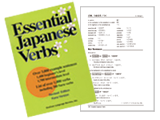
We publish Essential Japanese Verbs.
Our book explains clearly about the meaning of each verb with explaining its usage.
Over 3,000 example sentences help you to master how to use Japanese verbs.

Essential Japanese Verbs includes 1,400 examples for beginner's level and 1,700 examples for intermediate level. All examples are voice-recorded.

The book is also available from all bookstores in Japan.

Overview - Verb Groupings

Japanese verbs can be classified in several ways.
The two most important classifications in learning Japanese verbs, group belonging and transitive or intransitive, are introduced here.

Classification according to conjugation

Japanese verbs have inflection. They are classified into three groupings according to the way they are conjugated.
Verbs in the same group follow the same rule when making various verb forms (with some exception).

Group 1 : most i-ending verbs (iki-masu, kaki-masu, ai-masu)
Group 2 : all e-ending verbs (tabe-masu, ake-masu, de-masu)
some i-ending verbs (mi-masu, i-masu, kari-masu)
Group 3 : two verbs; shimasu and kimasu (to come)

Transitive verbs and Intransitive verbs

Japanese transitive and intransitive verbs are written using the same Kanji but are read differently in many cases.

In our materials, they are entered separately; "vt." is used to indicate transitive verb, "vi." for intransitive verb.

ex. kowashimasu (vt.) Transitive verb
kowaremasu (vi.) Intransitive verb

Kodomo wa jitensha o kowashimashita.

My child broke a bicycle.

Jitensha wa kowaremashita.

A bicycle broke.

Overview - Verb Conjugation

In our materials, we pick up 17 verb conjugation forms.
To make each form, other than the masu form, there are certain rules which must be followed depending on which group a verb belongs to.

masu form masu masu form affirmative
masen masu form negative
mashita masu form past affirmative
masendeshita masu form past negative
     
Plain form root form Plain form affirmative (dictionary form)
nai form Plain form negative
ta form Plain form past affirmative
nakatta form Plain form past negative
     
Other forms te form
Conditional form (ba form)
Potential form
Imperative form
Volitional form
Passive form
Causative form
Causative passive Long form
Causative passive Short form

Verb Forms

We give brief explanations for each form.

Verb Conjugation Tables

We have provided verb conjugation tables for each form.
You can learn how to make each form according to the group a verb belongs to.

Copyright (C)CosCom Language Service, Inc.All Rights Reserved.

Contact